Tag Archives: pediatrics

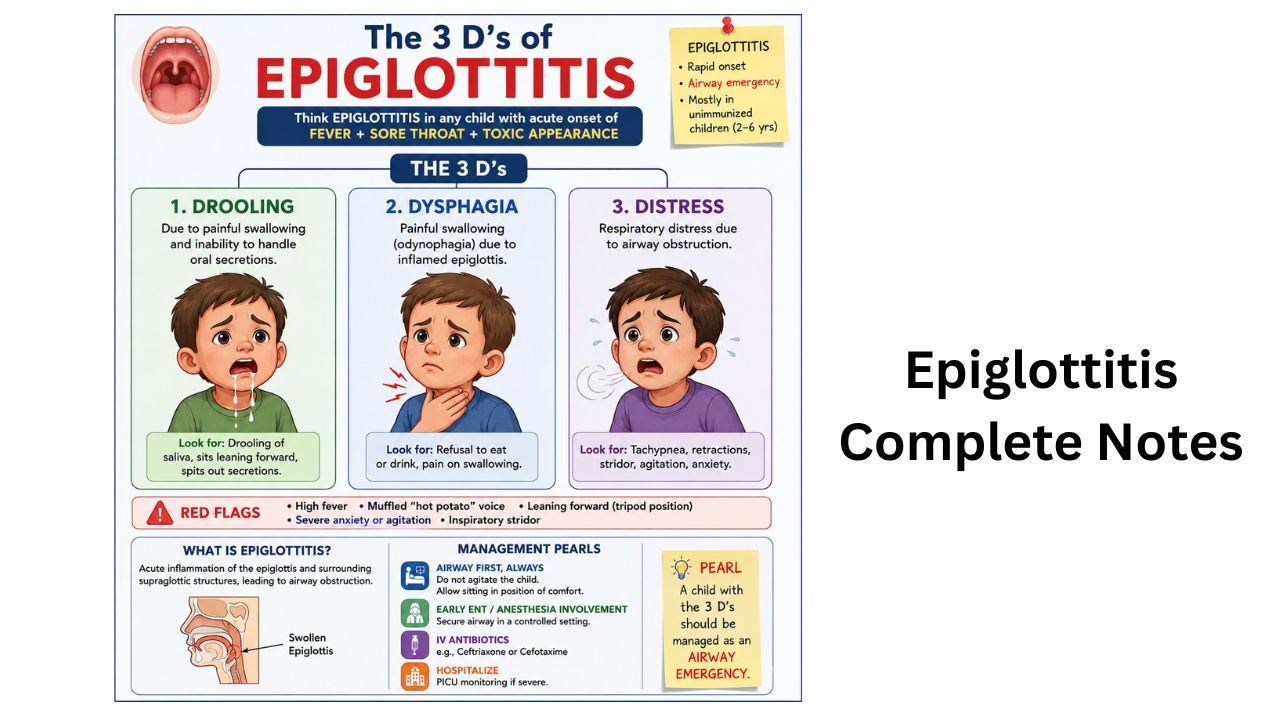
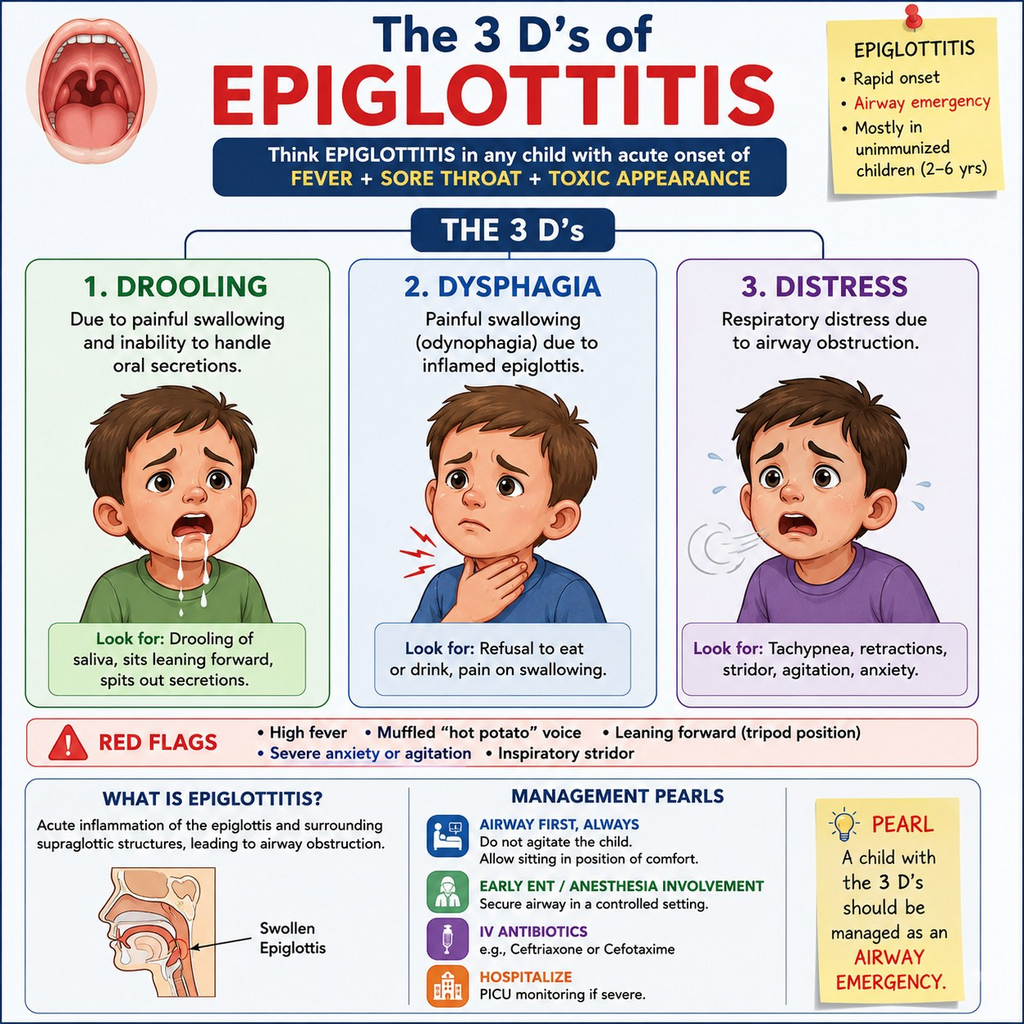
3 d of epiglottitis

Epiglottitis – 5 clinical features, Short Notes

Definition

Epiglottitis is an acute inflammation and swelling of the epiglottis (a flap of cartilage at the base of the tongue that prevents food from entering the airway).
It is a medical emergency because swelling can rapidly block the airway. (Mayo Clinic)


Anatomy and Function of Epiglottis

  • Located above the larynx.
  • Acts like a “lid” over the trachea during swallowing.
  • Prevents aspiration of food and liquids into the lungs.

Causes

Infectious Causes

  • Haemophilus influenzae type b (Hib) – classic cause in children
  • Streptococcus pneumoniae
  • Streptococcal species
  • Staphylococcus aureus
  • Viral or fungal infections (less common)

Non-infectious Causes

  • Hot liquid burns
  • Trauma to throat
  • Chemical injury
  • Smoking/vaping or inhaling drugs (Mayo Clinic)

Risk Factors

  • Lack of Hib vaccination
  • Weak immune system
  • Diabetes
  • Smoking
  • Young children (historically), though now more common in adults

Clinical Features

Symptoms

  • Severe sore throat
  • Fever
  • Difficulty swallowing (dysphagia)
  • Painful swallowing (odynophagia)
  • Drooling
  • Muffled or “hot potato” voice
  • Difficulty breathing
  • Stridor (high-pitched breathing sound)

Signs

  • Patient sits leaning forward (tripod position)
  • Anxiety/restlessness
  • Cyanosis in severe cases

Classic Presentation

“3 D’s” of Epiglottitis

  1. Drooling
  2. Dysphagia
  3. Distress (respiratory)

Diagnosis

Clinical Diagnosis

  • Do not aggressively examine throat in severe cases because it may worsen airway obstruction.

Investigations

  • Laryngoscopy
  • Neck X-ray → Thumb sign
  • Blood culture/throat swab
  • Pulse oximetry (Mayo Clinic)

Management

Emergency Management

  1. Secure airway first
    • Oxygen
    • Endotracheal intubation if needed
    • Rarely tracheostomy
  2. Medications
    • IV antibiotics
    • Corticosteroids
    • IV fluids
  3. ICU monitoring

Complications

  • Sudden airway obstruction
  • Respiratory failure
  • Sepsis
  • Death if untreated (Mayo Clinic)

Prevention

  • Hib vaccination is the best preventive measure.
  • Good hygiene and infection control.

Difference Between Epiglottitis and Croup

FeatureEpiglottitisCroup
OnsetSuddenGradual
FeverHighMild
CoughUsually absentBarking cough
DroolingPresentRare
VoiceMuffledHoarse
AgeOlder children/adultsYoung children
EmergencySevere emergencyUsually mild

Key Points to Remember

  • Life-threatening airway emergency.
  • Drooling + stridor + muffled voice = suspect epiglottitis.
  • Do not force throat examination.
  • Airway management is priority.
  • Hib vaccine greatly reduced cases.

Epiglottitis

Approach to a Child with Wheeze

1. Definition

  • Wheeze is a high-pitched, musical, continuous sound produced by airflow through narrowed airways, typically during expiration.
  • Indicates airway obstruction at any level (from trachea to small bronchi).

2. Initial Assessment

A. ABC Assessment

  • Airway: Ensure patency; look for obstruction (secretions, foreign body).
  • Breathing:
    • Respiratory rate, effort (retractions, nasal flaring, grunting)
    • Oxygen saturation (SpO₂)
    • Presence and distribution of wheeze
    • Work of breathing (mild / moderate / severe)
  • Circulation: Heart rate, capillary refill time, BP, color.

B. Severity Assessment

SeverityFeatures
MildSpeaking in sentences, SpO₂ > 94%, mild wheeze
ModerateBreathless, feeding difficulty, SpO₂ 90–94%
SevereCannot talk/feed, SpO₂ < 90%, exhaustion, cyanosis, silent chest

3. Focused History

AspectKey Points
Onset & CourseSudden (foreign body) vs gradual (infection/asthma)
Frequency/PatternRecurrent vs first episode
TriggersViral infection, allergen, exercise, cold air, smoke
Associated SymptomsFever, cough, coryza, vomiting, feeding difficulty
Past Medical HistoryPrevious wheezing, atopy, eczema, prematurity, GERD
Family/Social HistoryAsthma, allergies, smoking, housing
Drug historyRecent medications, response to bronchodilators

4. Physical Examination

  • General: Distress, cyanosis, growth, hydration.
  • Respiratory system:
    • Chest expansion, use of accessory muscles
    • Percussion (hyperresonant / dull)
    • Auscultation:
      • Wheeze: polyphonic (asthma/viral), monophonic (focal obstruction)
      • Air entry: symmetrical or reduced
      • Crackles: suggest infection or bronchiolitis
  • Cardiac: Murmurs (congenital lesions)
  • Other systems: Skin (eczema), ENT (allergic rhinitis), clubbing.

5. Differential Diagnosis

Age GroupCommon Causes
Infant (<1 yr)Bronchiolitis, congenital airway anomalies, aspiration, GERD
Toddler (1–5 yr)Viral-induced wheeze, foreign body aspiration, asthma
Older child (>5 yr)Asthma, allergic bronchitis, chronic suppurative lung disease

6. Investigations

(Usually guided by clinical picture; many cases diagnosed clinically)

  • Pulse oximetry – essential.
  • Chest X-ray – if first episode, focal findings, suspicion of foreign body/pneumonia.
  • Blood tests – if severe or infection suspected.
  • Allergy testing / IgE – in recurrent or atopic cases.
  • Spirometry / Peak Flow – for older cooperative children (asthma diagnosis).
  • Bronchoscopy – if persistent localized wheeze or suspicion of foreign body.

7. Management

A. Immediate Management

  • Mild/Moderate:
    • Nebulized or inhaled salbutamol (via spacer or nebulizer)
    • Oxygen if SpO₂ < 94%
    • Oral prednisolone if known asthma or recurrent wheeze
  • Severe / Life-threatening:
    • High-flow oxygen
    • Nebulized salbutamol ± ipratropium bromide
    • IV steroids (hydrocortisone)
    • IV magnesium sulfate / aminophylline / salbutamol if poor response
    • Consider PICU referral

B. Underlying Cause

  • Bronchiolitis – supportive (O₂, fluids, suction)
  • Foreign body – urgent ENT/pulmonary referral
  • Asthma – follow stepwise management (as per BTS/SIGN or GINA)

8. Long-term Management

  • Identify triggers and educate parents on avoidance.
  • Asthma education: inhaler technique, action plan.
  • Follow-up to reassess control and adjust therapy.

9. Red Flags

  • Silent chest, exhaustion, cyanosis
  • Poor air entry or asymmetry
  • Persistent localized wheeze
  • Failure to thrive or recurrent pneumonia
  • Sudden onset without infection (→ foreign body)

10. Summary Table

StepKey Action
1ABC and severity assessment
2Focused history
3Physical examination
4Consider differential diagnoses
5Targeted investigations
6Manage acutely + treat cause
7Educate and follow-up

Top 5 Facts about Gower’s Sign: How to easily demonstrate Gower’s sign?

Gowers’ sign is a medical sign that indicates weakness in the pelvic girdle and proximal lower limb muscles. It’s characterized by a patient using their hands to “walk” up their body to get to a standing position. 

10 red flags in a relationship that you should never ignore?

How is Gower’s Sign Performed?

  1. Start in a supine or sitting position
  2. Roll onto your stomach with your arms and legs extended
  3. Put your hands on the ground and shift your weight onto your extended arms
  4. Push your body backward to extend your legs
  5. Put your hands on your knees
  6. Walk your hands up your thighs until you’re standing

What it can indicate

  • Duchenne muscular dystrophy: A characteristic sign of this condition 
  • Guillain-Barré syndrome (GBS): Can be a sign of recovery from GBS 
  • Pelvic girdle weakness: A sign of weakness in the pelvic girdle and proximal lower extremity muscles 
  • Diskitis: Can be associated with diskitis at the L4-5 intervertebral space 

Who described it?

Gowers’ sign was described by neurologist Sir William Richard Gowers in 1879. 

Now lets dig into DMD.

Read now: Why is the MDF Stethoscope today’s No 1 Choice as Medical Professionals?

Duchenne Muscular Dystrophy (DMD)

Duchenne Muscular Dystrophy (DMD) is the most common and severe form of progressive muscular dystrophy in children. It belongs to a group of primary myopathies characterized by a progressive, genetic-based degeneration and death of muscle fibers.

1. Genetic Profile and Pathogenesis

  • Inheritance: DMD is an X-linked recessive disorder, almost exclusively affecting males and carried by females. Approximately one-third of cases result from de novo (new) mutations.
  • Molecular Defect: It is caused by a mutation (typically a deletion) in the gene for dystrophin located on chromosome Xp21.
  • Mechanism: Dystrophin is the longest known human gene and encodes a protein that connects the muscle fiber cytoskeleton to the surrounding extracellular matrix. Without functional dystrophin, muscle cells undergo chronic damage, necrosis, and replacement by fat and fibrous tissue.

2. Clinical Features

DMD typically presents between the ages of 2 and 5 years.

  • Early Signs: Delayed motor milestones (especially late walking) and mild speech or language delay are often the first indicators.
  • Muscle Weakness: Progressive, symmetric weakness begins in the pelvis and hip girdle, later involving the shoulder girdle.
  • Gait and Mobility: Affected children exhibit a waddling (Trendelenburg) gait, frequent falls, and difficulty climbing stairs (mounting them “one by one”).
  • Gower Sign: A classic clinical finding where the child, unable to stand up normally from the floor, must turn prone and “climb up his own thighs” with his hands to reach an upright position.
  • Pseudohypertrophy: Striking enlargement of the calf muscles occurs because muscle tissue is replaced by fat and connective tissue rather than true muscle growth.
  • Intellectual Function: Approximately 20% to 30% of boys have learning difficulties or non-progressive intellectual impairment.

3. Diagnostic Evaluation

Diagnosis should be initiated at the first clinical suspicion.

  • Serum Creatine Kinase (CK): Remarkably high levels (usually 10 to 40 times normal) are a hallmark of the disease.
  • Genetic Testing: Direct dystrophin gene testing is now the preferred definitive method and often avoids the need for a muscle biopsy.
  • Electromyography (EMG): Shows a “myopathic” pattern, including reduced amplitude and duration of motor unit potentials.
  • Muscle Biopsy: If performed, shows fiber necrosis, phagocytosis, and increased endomysial fat and connective tissue.

4. Progression and Complications

  • Loss of Ambulation: Most boys become wheelchair-bound by age 10 to 13.
  • Orthopedic: As weakness progresses, many develop scoliosis, particularly once they are no longer walking.
  • Cardiac: Progressive cardiomyopathy and persistent tachycardia develop in nearly all patients.
  • Respiratory: Weakness of the diaphragm and intercostal muscles leads to nocturnal hypoxia and eventual respiratory failure.
  • Prognosis: Death typically occurs in the late teens or 20s from cardiorespiratory complications.

5. Management

Management requires a specialist multidisciplinary team.

  • Corticosteroids: (e.g., Prednisone or Deflazacort) are the mainstay of treatment, as they preserve mobility, improve muscle strength, and prevent scoliosis.
  • Supportive Care: Physiotherapy and splinting are used to prevent contractures. Nocturnal hypoxia may be managed with overnight CPAP.
  • Novel Therapies: Research into exon-skipping drugs (e.g., Ataluren or Eteplirsen) allows for the production of small amounts of functional dystrophin in patients with specific mutations.
  • Genetic Counseling: Crucial for the family to detect female carriers and discuss antenatal diagnosis.

DMD vs. Becker Muscular Dystrophy (BMD): BMD is a milder allelic variant where some functional dystrophin is produced. BMD features a later onset (average 11 years), a slower course, and patients typically remain ambulatory into their late 20s or beyond, with many living into middle age.

Who described Gower’s sign?

Sir William Richard Gowers

What can Gower’s Sign indicate?

Duchenne muscular dystrophy, Guillain-Barré syndrome (GBS), pelvic girdle weakness, and diskitis.