Definition of Waist-to-Hip Ratio (WHR) (waist hip circumference ratio)
Waist-to-Hip Ratio (WHR) is the ratio of the circumference of the waist to that of the hips. It is calculated by dividing the waist measurement by the hip measurement. WHR is an indicator of body fat distribution and is used as a measure of health risk associated with obesity.
WHR (waist hip circumference ratio) Classification
The WHR classification is as follows:
risk level
Male
female
lower risk
less than 0.9
less than 0.8
moderate risk
0.92-0.99
0.82-0.84
high risk
more than equal to 1
more than equal to 0.85
A higher WHR indicates greater central fat distribution, which is associated with an increased risk of cardiovascular disease, type 2 diabetes, and other obesity-related conditions.
Technique of measuring waist and hip circumference
Waist Circumference
Measure the smallest circumference of the abdomen, just above the belly button (navel), after exhaling naturally.
Waist hip citcumference ratio
Hip Circumference
Measure the largest circumference of the hips, typically around the widest part of the buttocks.
The waist and hip circumference ratio calculator
Calculate Your Waist-to-Hip Ratio (WHR)
Result:
How to Reduce Waist and Hip Circumference
1. Balanced Diet: Eat a diet rich in fruits, vegetables, lean protein, and whole grains while avoiding excessive sugar and processed foods.
2. Regular Exercise:
Engage in aerobic exercises (e.g., running, swimming, cycling) to burn fat.
Incorporate strength training to build muscle and improve metabolism.
3. Hydration: Drink plenty of water to support digestion and metabolism.
4. Adequate Sleep: Aim for 7-9 hours of sleep per night to regulate hormones that control appetite and fat storage.
5. Stress Management: Practice mindfulness, meditation, or yoga to manage stress and avoid emotional eating.
FAQs
1. What is Waist-to-Hip Ratio (WHR), and why is it important?
WHR is the size of your waist divided by the size of your hips. It tells how fat is stored in your body. A high WHR can mean a higher risk of heart problems, diabetes, and other health issues.
2. How do I measure my waist and hips correctly?
For your waist, measure just above your belly button (the narrowest part of your abdomen). For your hips, measure around the widest part of your hips and buttocks. Use a tape measure, and make sure it’s snug but not too tight.
3. How can I lower my waist-to-hip ratio?
Eat healthy foods like fruits, vegetables, and lean proteins. Exercise regularly (cardio and strength training). Drink enough water, sleep well, and reduce stress. These steps can help reduce fat, especially around your waist, and improve your overall health.
Gowers’ sign is a medical sign that indicates weakness in the pelvic girdle and proximal lower limb muscles. It’s characterized by a patient using their hands to “walk” up their body to get to a standing position.
Duchenne Muscular Dystrophy (DMD) is the most common and severe form of progressive muscular dystrophy in children. It belongs to a group of primary myopathies characterized by a progressive, genetic-based degeneration and death of muscle fibers.
1. Genetic Profile and Pathogenesis
Inheritance: DMD is an X-linked recessive disorder, almost exclusively affecting males and carried by females. Approximately one-third of cases result from de novo (new) mutations.
Molecular Defect: It is caused by a mutation (typically a deletion) in the gene for dystrophin located on chromosome Xp21.
Mechanism: Dystrophin is the longest known human gene and encodes a protein that connects the muscle fiber cytoskeleton to the surrounding extracellular matrix. Without functional dystrophin, muscle cells undergo chronic damage, necrosis, and replacement by fat and fibrous tissue.
2. Clinical Features
DMD typically presents between the ages of 2 and 5 years.
Early Signs: Delayed motor milestones (especially late walking) and mild speech or language delay are often the first indicators.
Muscle Weakness: Progressive, symmetric weakness begins in the pelvis and hip girdle, later involving the shoulder girdle.
Gait and Mobility: Affected children exhibit a waddling (Trendelenburg) gait, frequent falls, and difficulty climbing stairs (mounting them “one by one”).
Gower Sign: A classic clinical finding where the child, unable to stand up normally from the floor, must turn prone and “climb up his own thighs” with his hands to reach an upright position.
Pseudohypertrophy: Striking enlargement of the calf muscles occurs because muscle tissue is replaced by fat and connective tissue rather than true muscle growth.
Intellectual Function: Approximately 20% to 30% of boys have learning difficulties or non-progressive intellectual impairment.
3. Diagnostic Evaluation
Diagnosis should be initiated at the first clinical suspicion.
Serum Creatine Kinase (CK): Remarkably high levels (usually 10 to 40 times normal) are a hallmark of the disease.
Genetic Testing: Direct dystrophin gene testing is now the preferred definitive method and often avoids the need for a muscle biopsy.
Electromyography (EMG): Shows a “myopathic” pattern, including reduced amplitude and duration of motor unit potentials.
Muscle Biopsy: If performed, shows fiber necrosis, phagocytosis, and increased endomysial fat and connective tissue.
4. Progression and Complications
Loss of Ambulation: Most boys become wheelchair-bound by age 10 to 13.
Orthopedic: As weakness progresses, many develop scoliosis, particularly once they are no longer walking.
Cardiac: Progressive cardiomyopathy and persistent tachycardia develop in nearly all patients.
Respiratory: Weakness of the diaphragm and intercostal muscles leads to nocturnal hypoxia and eventual respiratory failure.
Prognosis: Death typically occurs in the late teens or 20s from cardiorespiratory complications.
5. Management
Management requires a specialist multidisciplinary team.
Corticosteroids: (e.g., Prednisone or Deflazacort) are the mainstay of treatment, as they preserve mobility, improve muscle strength, and prevent scoliosis.
Supportive Care: Physiotherapy and splinting are used to prevent contractures. Nocturnal hypoxia may be managed with overnight CPAP.
Novel Therapies: Research into exon-skipping drugs (e.g., Ataluren or Eteplirsen) allows for the production of small amounts of functional dystrophin in patients with specific mutations.
Genetic Counseling: Crucial for the family to detect female carriers and discuss antenatal diagnosis.
DMD vs. Becker Muscular Dystrophy (BMD): BMD is a milder allelic variant where some functional dystrophin is produced. BMD features a later onset (average 11 years), a slower course, and patients typically remain ambulatory into their late 20s or beyond, with many living into middle age.
Snake bite piercings have been made since lomg ago but they had never been into medical attention till lately when there had been cases of multiple medical illnesses and side effects with extreme cases of snake bite piercings.
Snake bite piercing are named after what they look like that is Fangs of a snake, or the bitemark of a snake.
The side effects and complications of snake bite piercings are listed down below in different heading.
Hence while they look pretty for what they are they can be devastatingly ugly like what they are named after.
There are typically Three location where the snake bite piercings can be kept. They include tongue, midline on lower lip, one side on lower lip and both side on lower lip.
A strict sterile precaution should be followed while making a snakebite piercing. This includes proper sterility of the sharps, wearing sterile gloves and sterile piercing site preparation.
The procedure starts by preparing all these instruments and then a sterile field is prepared. With sterile precaution the piercing is done and a sterile temporary assessory is put on in the piercing.
Additionally, an antiseptic/antibiotic preparation might be applied post procedure. These products include Mupirocin, Polysporin, Betadine, Chlorhexidine etc.
No dressing i applied and the wound is left open to heal. If there are any signs of infection seen like pain, swelling, redness, discharge etc you should contact your doctor immidiately.
The person doing this prcedure should be extra cautious not to prick htemselves and should make sure that the client does not have any infections like HIV, Hepatitis (B and C), syphillis etc.
Managing Pain and Discomfort: Medical Insights for Snake Bite Piercing
The pain management can be achieved via application of local anesthetic. Local anesthetic of choice is lignocaine with or without adrenaline (1-2%).
The client can be adviced to take over the counter (OTC) pain medication like Ibuprofen, Paracetamol (Acetaminophen), naproxen, ketorolac, diclofenac or aceclofenac (prescription).
Healing and Aftercare: Medical Recommendations for Snake Bite Piercings
It’s important to note that while there are plenty of risks, proper care, hygiene, and following the guidance of a professional piercer can help minimize these potential risks and complications.
Remember that, it’s important to consult with a healthcare professional or a qualified well trained piercer for personalized advice and guidance made for your specific situation and need.
The healing of the piercing can sometimes take longer than told by the piercer. But you shouldnt panic and wait for a couple or more days. If it still doesn’t heal then you should immidiately seek advice from a healthcare professional.
Potential Risks and Complications of Snake Bite Piercings: A Medical Perspective
Infection
Like any other piercing, snake bite piercings also carry a risk of infection. Improper aftercare, unsterilized equipment, or poor hygiene can increase the risk of infection.
Swelling and Bruising
Initial swelling and bruising are common after getting snake bite piercings. Excessive swelling can potentially lead to long term discomfort and difficulties with eating or speaking.
Rejection or Migration
There is a possibility that the body may reject the snake bite piercings, leading to the piercing4 being pushed out of the skin or the piercing shifting from its original position.
Gum and Tooth Damage
Snake bite piercings located near the lower lip can come into contact with the gums and teeth. Continuous contact or improper jewelry size can result in gum recession, enamel erosion, chipped teeth, or damage to dental work.
Allergic Reactions
Some individuals may have allergic reactions to certain metals used in snake bite piercing jewelry, particularly if they have sensitivities or allergies to nickel or other common metals. Allergic reactions can manifest as redness, itching, swelling, or irritation around the piercing site. Long-Term Effects and Oral Health Considerations of Snake Bite Piercings
Snake bite piercing tongue is one of the common tngue piercing. This has been done by many famous celibrities aroud the world and has successfully been on the market for long time.
2. Viper bites piercing
Viper bites piercing is a type of snake bite piercing named after a famous poisonous snake Viper. This signifies this piercing is as furious as viper.
3. Multiple Snakebite Piercing
Multiple snake bite piercing is one type of piercing commonly done in a goth culture. There can be more than one in lower lip.
4. Midline Snakebite piercing
Piercing in the midline lip is most beautiful and is done by somany more celebrities as well.
full ring or half ring piercing with diamond are also equally famous.
5. Single unilateral Snakebite piercing/one side Snake bite piercings
Unilateral piercing is beautiful like damn. The side look or even the front look is so pretty and will make you attractive.
This doen’t make you uncomfortble and doesn’t affect you speech either.
FAQs
Are snake bite piercings painful?
Generally no. But Snakebite piercings can occasionally be painful if done inappropriately, infected or pain management or anesthesia is not done properly.
How long does it take for snake bite piercings to heal?
It usually taked 5 to 10 days. Contact your doctor if it is taking longer.
What are the potential risks and complications associated with snake bite piercings?
Potential risks include pain, bleeding, infection, allergy, rejection and disfigurement. Discuss with your piercer prior to procedure.
Can snake bite piercings damage teeth or gums?
Piercing itself may not damage it. But of you use low quaity and allergen, chemical containing piercings your teeth and gums may damange. Occasionally the damage ay occur by using unnecessarily large, uncomfortable and bad quality built ornament.
Are there any specific aftercare instructions for snake bite piercings to prevent infection?
Strict infection prevention and sterile precaution should be followed by the piercer and the client.
AHAs and BHAs are the types of hydroxy acids that help in exfoliating the skin. AHA and BHA are type of medical skincare products that are found in multiple skin care products like moisurizers, creams, scrubs, peelers, cleansers, toners, masks etc.
AHA fullform: Alpha hydroxy acid
BHA full form: Beta hydroxy acids
PHA full form: Polyhydroxy acids
They are hydroxy acids that are derived from fruit products.
After use of AHA BHA PHA skincare products you’ll gradually start feeling that your skin is softer than before.
What is AHA BHA toner
AHA BHA PHA toners are the types of toners that help in exfoliating the outermost layer of skin and in the hair follicles and sebaceous glands.
This helps in clearing the dead tissue and help the skin get proper exposure to outer environment and helps make skin look better.
AHA vs BHA skincare products
Read more regarding AHA vs BHA in this healthline website link.
There is no exact difference between AHA BHA and PHA composition products and theres none better than others. The common differences can be seen below.
In general, AHA has anti aging effects, anti drying effets and BHA has tone maintainance property.
Paula’s choice aha bha toner (Paula’s choice toner)
Paula’s choice has been one of the long standing and doctor’s recommended skin peeler available in the market. Toda it ias been one of the top choices due to its good quality and effective results. There are minimal side effects with proper use and is relatively cost-effective as well.
Can i use cosrx aha bha toner with vitamin c? Answer: Yes you can. But try to alternate the time when you apply the product. Apply one at nightime while other at morning or vice versa.
Can i use cosrx aha bha toner everyday? Yes you can. But make sure youre not getting side effects and your skin has not thinned a lot. If youthink youre using it a lot then contact your dermatologist. Yoou can contact doctor at our site or here.
What are the side effects of skin peelers? They may irritate your skin, make it dry and may cause photosensitivity. Please consult your doctor regarding this.
What amount should I apply? The dose is not fixed but individual. You should apply the amunt that makes very thin layer in your face and is not excess. Always protect your eyes from the product as these products may harm your eyes.
What should I do if I am pregnant? These skincare products are NOT recommended for pregnant women if they contain retinol (vitamin A1). The products containing AHA, BHA and PHA are generally safe for pregnant woman. Please consult your doctor if you’re pregnant.
When it comes to our health, paying attention to even the smallest symptoms is vital. Chest pain is often associated with heart problems, however did you recognize that arm pain can also be a potential indicator? In this article, we are able to discover the relationship between arm pain and heart troubles, supporting you recognize while to are trying to find medical attention and a way to stay proactive approximately your cardiovascular health.
Chest pain with heart disease
Understanding Arm pain
Arm pain can be one of the symptoms of heart disease. Arm ache/pain can be experienced in various methods, along with aching, pulsating, or a pins-and-needles sensation. Even as no longer all times of arm ache indicate coronary heart troubles, it is crucial to recognize while it may probably be a symptom of an underlying cardiovascular issue.
Possible causes of pain to the left arm
One of the many causes of left arm pain is heart disease but it is not so common. More then that isolated left sided arm pain can be less likely due to the heart disease rather it can be musculoskeletal or neurological cause. So, it’s vital to notice that arm pain can also be resulting from factors like muscle pressure, injury, or stress on nerves. For an accurate diagnosis, it’s recommended to consult with a healthcare expert.
Pain and coronary heart diseases
Arm pain as a Symptom of coronary heart issues it’s important to note that not all people experiencing coronary heart problems will have arm ache, and now not all arm ache indicates a heart condition. however, arm ache, especially in the left arm, is typically related to coronary heart issues. that is because the nerves from the coronary heart and the arm share pathways inside the spinal twine, that may lead to referred ache.
Left sided chest pain with heart disease
Nature of pain in heart disease
Types of heart situations and Arm ache a) heart assault: throughout a heart attack, blood drift to the heart is blocked, inflicting chest ache or pain. This pain can radiate to the left arm, shoulder, or even the jaw. if you revel in excessive, chronic, or unexpected arm pain in conjunction with other heart assault symptoms like chest pain, shortness of breath, and dizziness, are trying to find instant medical attention.
The pain of heart attack usually last more than 15 minutes and so arm pain of heart attack also lasts more than 15 minutes. To know your arm pain is heart related you should have other risk factors as well as heart disease symptoms.
What does heart attack arm pain feel like?
Heart attack pain is usually continuous type, vague and pressing type. It will be associated with central chest, left chest, jaw, neck , or upper abdominal pain, It is also associated with shortness of breath, weakness and sweating. Usually the pain is very severe.
Is always left arm involved in heart attack?
No. It is mostly left arm but sometimes the pain might be radiated to the right arm as well during the heart attack and shoul we be equaly cautious regarding to the right arm as well. Ignoring this fact even the highly talented healthcare personnel may miss the diagnosis leading to bad outcomes.
Arm pain and heart attack: which arm hurts during heart attack?
When to are trying to find scientific interest arm pain on my own might not continually suggest a coronary heart trouble, however in case you enjoy any of the subsequent signs similarly to arm ache, it is important to seek on the spot scientific interest:
6 Symptoms of heart disease
Chest pain or discomfort
Shortness of breath
Sweating
Nausea or vomiting
Lightheadedness or fainting
Pain that radiates down the left arm, jaw, or shoulder
At the same time as arm pain may have various causes, it is essential to be aware about the capacity connection among arm ache and coronary heart problems. understanding the signs and symptoms associated with heart conditions, including chest pain and arm ache, permit you to make informed choices about in search of scientific assistance. remember, it is always higher to misunderstand the side of caution and seek advice from a healthcare expert when you have issues about your heart fitness.
The follicular phase is the initial stage of the menstrual cycle, marked by the development and maturation of ovarian follicles. It begins on the first day of menstruation and lasts until ovulation. During this phase, the hypothalamus releases gonadotropin-releasing hormone (GnRH), which stimulates the anterior pituitary gland to release follicle-stimulating hormone (FSH). FSH, in turn, acts on the ovaries, promoting the growth and development of several follicles. As the follicles mature, they produce estrogen, which has various effects on the body. Estrogen stimulates the thickening of the uterine lining (endometrium) in preparation for potential implantation and inhibits further FSH production to prevent excessive follicle development. Eventually, one dominant follicle emerges and continues to mature, while the others undergo atresia. The follicular phase concludes with a surge in luteinizing hormone (LH), triggered by rising estrogen levels, which sets the stage for ovulation and the subsequent luteal phase of the menstrual cycle.
A. Follicle-Stimulating Hormone (FSH)
Initiates follicular development in the ovaries
Stimulates the production of estrogen
B. Estrogen
Promotes the proliferation of the endometrium
Inhibits follicle-stimulating hormone (FSH) to prevent excessive follicle development
Stimulates the production of luteinizing hormone (LH)
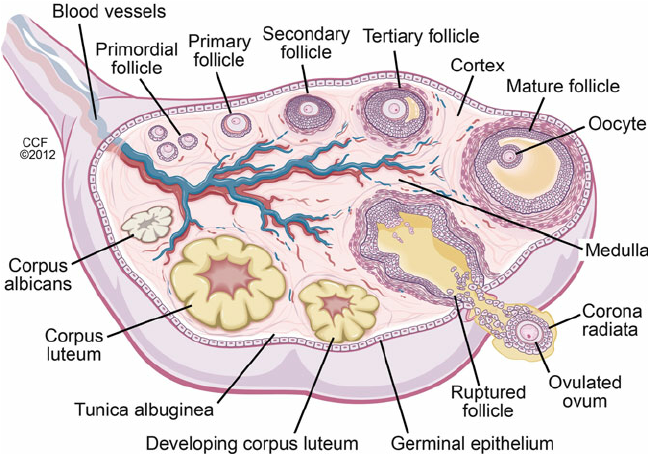
Ovulation in humans refers to the release of a mature egg (oocyte) from the ovary into the fallopian tube. It is a crucial event in the menstrual cycle and typically occurs around the midpoint of the cycle, approximately 14 days before the start of the next menstrual period. Ovulation is triggered by a surge in luteinizing hormone (LH) levels, which is primarily stimulated by high levels of estrogen. This surge causes the dominant ovarian follicle, which has been developing during the follicular phase, to rupture and release the mature egg.
The egg is then swept into the fallopian tube, where it awaits fertilization by sperm. Ovulation is a brief process, usually lasting only a few minutes to hours. It marks the fertile period of a woman’s menstrual cycle, and successful fertilization during this time can lead to pregnancy. If fertilization does not occur, the unfertilized egg disintegrates, and the woman enters the subsequent luteal phase, leading to menstruation and the beginning of a new cycle.
A. Luteinizing Hormone (LH)
Surge in LH levels causes the dominant follicle to rupture and release the mature egg
Initiates the conversion of the ruptured follicle into the corpus luteum
III. Luteal Phase:
The luteal phase is a stage of the menstrual cycle that follows ovulation and precedes menstruation. It is characterized by the presence and activity of the corpus luteum, which forms from the ruptured ovarian follicle after the release of the egg during ovulation. The luteal phase typically lasts for about 10 to 16 days and is marked by significant hormonal changes.
Once the egg is released, the ruptured follicle undergoes a transformation and becomes the corpus luteum. The corpus luteum primarily produces progesterone, along with smaller amounts of estrogen and other hormones. Progesterone plays a crucial role in preparing the uterus for possible embryo implantation.
Ovarian cycle in menstrual cycle
During the luteal phase, the increased levels of progesterone and estrogen contribute to the thickening of the uterine lining (endometrium), making it more receptive to a fertilized egg. The endometrium develops a rich blood supply and glandular secretions to support embryo implantation.
If fertilization occurs during the luteal phase, the fertilized egg implants itself into the thickened endometrium, leading to pregnancy. The corpus luteum continues to produce progesterone, maintaining the endometrium and supporting the early stages of pregnancy until the placenta takes over hormone production.
However, if fertilization does not occur, the corpus luteum gradually regresses, leading to a decrease in progesterone and estrogen production. As hormone levels decline, the endometrium is no longer sustained, and it begins to break down. This breakdown results in the shedding of the endometrial lining, leading to menstrual bleeding and the start of a new menstrual cycle.
The length of the luteal phase remains relatively constant for each individual, typically ranging from 10 to 16 days. Monitoring the length of the luteal phase is important in assessing the overall health of a woman’s menstrual cycle and fertility. A consistently short luteal phase, known as luteal phase defect, may pose challenges for successful implantation and can be associated with fertility issues.
A. Corpus Luteum
Secretes progesterone
Supports the maintenance of the endometrium for potential embryo implantation
Inhibits the production of FSH and LH to prevent further ovulation
B. Progesterone
Thickens the endometrium, preparing it for potential implantation
Suppresses the immune response to protect a developing embryo
Prepares the mammary glands for potential lactation
IV. Menstruation:
Menstruation, also known as a menstrual period or simply a period, is a natural process that occurs in humans with reproductive capacity. It is a crucial part of the menstrual cycle and refers to the monthly shedding of the uterine lining (endometrium) when pregnancy does not occur. Menstruation typically lasts for about 3 to 7 days, but the duration can vary from person to person. The onset of menstruation, known as menarche, usually begins during puberty and continues until menopause.
During menstruation, hormonal changes, specifically a decrease in progesterone and estrogen levels, trigger the release of substances that cause the blood vessels in the endometrium to constrict and the lining to break down. This results in the menstrual flow, which consists of blood, mucus, and tissue from the uterus, exiting the body through the vagina. Menstruation serves as an indicator of reproductive health and plays a significant role in the reproductive cycle, preparing the uterus for potential pregnancy in the subsequent menstrual cycle
A. Decreased Levels of Estrogen and Progesterone
Withdrawal of hormonal support leads to endometrial shedding
Initiates menstrual bleeding
Conclusion: Summary of roles of hormones in menstrual cycle
The menstrual cycle is a highly regulated process involving a precise sequence of hormonal events. Understanding the roles of hormones in each phase is essential for medical students. From follicular development to ovulation, corpus luteum formation, and menstrual shedding, hormones play a critical role at every step. By grasping this intricate dance, medical students can develop a comprehensive understanding of reproductive physiology and provide better care to their patients in the future.