Table of Contents
Introduction of Evolution
Evolution is the biological process by which populations of organisms change over generations through variations in inherited traits. These changes occur due to mechanisms such as mutation, natural selection, genetic drift, and gene flow. Over long periods of time, evolution leads to the development of new species and the diversification of life on Earth.
A simple example is the peppered moth, where darker moths became more common during the industrial revolution due to better camouflage in polluted environments. Another example is the Darwin’s finches, where different species evolved from a common ancestor and developed varied beak shapes to adapt to different food sources.
Evolution explains both small changes within species (microevolution, such as antibiotic resistance in bacteria) and large-scale changes that result in new species (macroevolution, such as the evolution of horses and humans).
Genetic Drift
Genetic drift is a random change in the frequency of alleles (gene variants) in a population over generations, especially due to chance events rather than natural selection.
It occurs mostly in small populations, where random events can strongly affect which genes are passed on.
Key points:
- It is random, not adaptive
- Strong effect in small populations
- Can lead to loss of genetic variation
- May cause fixation or disappearance of alleles
Examples:
- Bottleneck effect: After a disaster (e.g., earthquake, epidemic), only a few individuals survive and reproduce, reducing genetic diversity.
- Founder effect: A small group separates and forms a new population with limited genetic variation (e.g., isolated island populations).
Genetic Shift (Antigenic Shift)
Genetic shift is a sudden, major change in the genetic makeup of a virus due to the reassortment of gene segments from different viral strains.
It is mainly seen in Influenza A virus because it has a segmented RNA genome and can infect multiple species (birds, pigs, humans).
Key points:
- It is sudden and major change
- Occurs due to reassortment of RNA segments
- Seen only in Influenza A
- Leads to new viral subtypes
- Can cause pandemics
Examples:
- 1957 Asian Flu Pandemic
- 1968 Hong Kong Flu Pandemic
- 2009 H1N1 Influenza Pandemic
Simple Difference
- Genetic drift → random changes in allele frequency in populations (evolutionary biology)
- Genetic shift → sudden genetic change in influenza viruses (virology, epidemiology)
Classic, High-yield Examples of Evolution
Here are classic, high-yield examples of evolution (good for exams and conceptual clarity):
1. Peppered moth (Industrial melanism)
- In pre-industrial England: light-colored moths were common.
- After industrial pollution: dark-colored moths increased (camouflage on soot-covered trees).
- After pollution control: light forms increased again.
➡️ Example of natural selection in real time
2. Darwin’s finches (Galápagos Islands)
- Different finch species evolved from a common ancestor.
- Beak shapes changed based on food type (seeds, insects, cactus).
➡️ Example of adaptive radiation
3. Antibiotic resistance in bacteria
- Bacteria like Staphylococcus aureus become resistant to antibiotics (e.g., MRSA).
- Due to selection of resistant mutants.
➡️ Example of rapid evolution under selection pressure
4. Darwin’s finches in modern studies (Beak size change)
- Beak size changed within a few generations during droughts.
➡️ Example of microevolution observed directly
5. Industrial insects (DDT resistance in mosquitoes)
- Mosquitoes evolved resistance to DDT after widespread use.
➡️ Example of human-driven selection
6. Horse evolution (fossil record)
- From small multi-toed ancestor (Eohippus) → modern single-toed horse (Equus).
➡️ Example of gradual evolution over millions of years
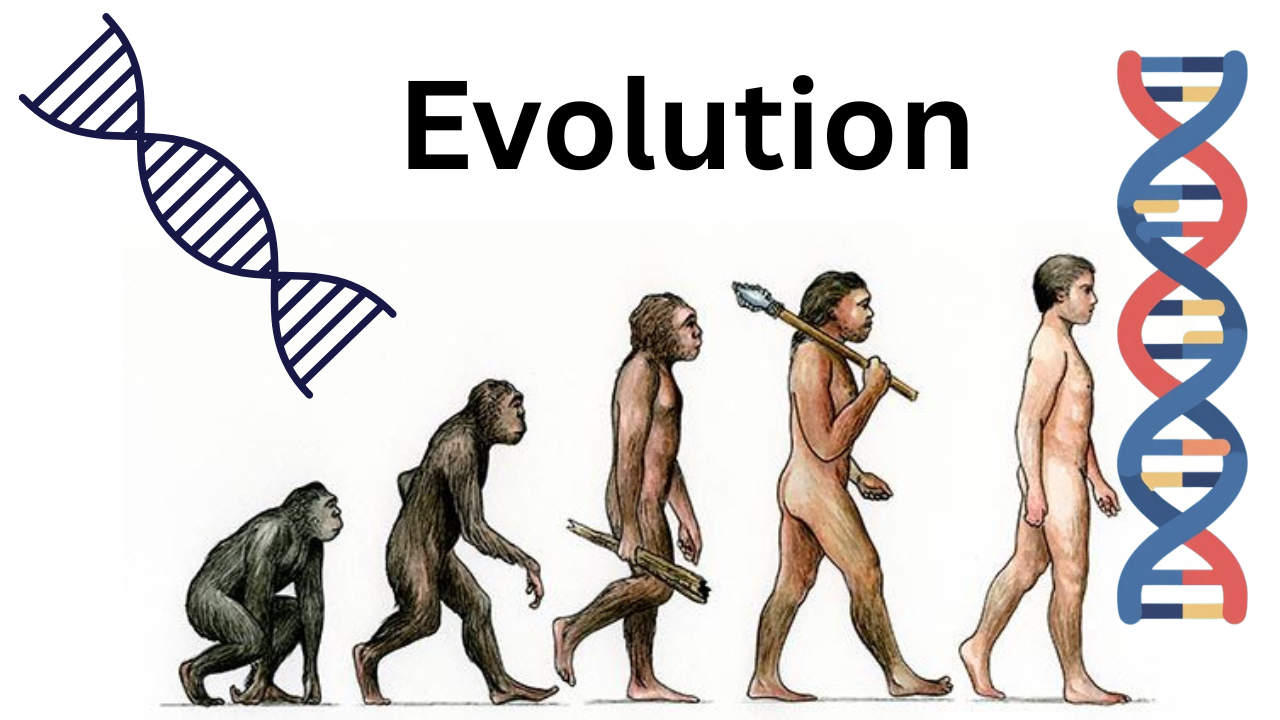
7. Human evolution
- From early hominins (Australopithecus) → Homo habilis → Homo erectus → Homo sapiens.
➡️ Example of macroevolution
8. Lenski’s E. coli experiment
- Long-term lab evolution showing new metabolic abilities evolving in bacteria over generations.
➡️ Direct experimental proof of evolution
Quick Exam Tip
- Microevolution: antibiotic resistance, moths
- Macroevolution: horse, human evolution
- Adaptive radiation: Darwin’s finches
| Feature | Antigenic Drift | Antigenic Shift |
|---|---|---|
| Definition | Minor, gradual changes in viral antigens due to point mutations | Major, abrupt change in viral antigens due to reassortment of gene segments |
| Mechanism | Accumulation of mutations in HA and/or NA genes | Exchange of gene segments between different influenza viruses |
| Magnitude of change | Small | Large |
| Frequency | Continuous, occurs every year | Rare, occurs at irregular intervals |
| Virus affected | Influenza A and B | Influenza A only |
| Population immunity | Partial immunity usually remains | Little or no pre-existing immunity |
| Epidemic/Pandemic | Causes seasonal epidemics | Causes pandemics |
| Genetic basis | Point mutations (genetic drift) | Reassortment (genetic shift) |
| Examples | Annual influenza outbreaks | 2009 H1N1 Influenza Pandemic, 1968 Hong Kong Flu Pandemic, 1957 Asian Flu Pandemic |
| Vaccine implication | Requires annual vaccine updates | May require development of a new vaccine |
Easy Memory Trick
DRIFT = Daily/Regular small changes
- D = Diminutive (small)
- R = Regular
- I = Influenza A & B
- F = Frequent
- T = Tiny mutations
SHIFT = Sudden Huge Influenza Transformation
- S = Sudden
- H = Huge change
- I = Influenza A only
- F = Few times (rare)
- T = Pandemic Threat
High-Yield Exam Point
Antigenic drift occurs in both Influenza A and B, whereas antigenic shift occurs only in Influenza A because Influenza A infects multiple species (humans, birds, pigs), allowing reassortment of segmented RNA genomes.
What is the main difference between genetic drift and natural selection?
Genetic drift is a random change in allele frequencies that occurs due to chance events, especially in small populations. It does not depend on whether a trait is beneficial or harmful.
In contrast, natural selection is a non-random process where individuals with advantageous traits survive and reproduce more, leading to adaptation over time.
Why does antigenic shift only occur in Influenza A virus?
Antigenic shift occurs only in Influenza A because it has a segmented RNA genome and can infect multiple species (humans, birds, pigs). This allows reassortment of gene segments when two different strains infect the same cell.
Influenza B generally infects only humans and lacks the same level of genetic mixing, so antigenic shift does not occur.
MCQs on Antigenic Shift Vs Antigenic Drift
1. Genetic drift is best described as:
A. Directional change due to natural selection
B. Random change in allele frequency
C. Gene flow between populations
D. Formation of new species by hybridization
✅ Answer: B. Random change in allele frequency
2. Genetic drift has the strongest effect in:
A. Large populations
B. Small populations
C. Populations under strong selection
D. All populations equally
✅ Answer: B. Small populations
3. Antigenic shift occurs due to:
A. Point mutation
B. Natural selection
C. Reassortment of gene segments
D. Gene duplication
✅ Answer: C. Reassortment of gene segments
4. Antigenic shift is seen mainly in:
A. Influenza B only
B. Influenza A only
C. Both Influenza A and B
D. All RNA viruses
✅ Answer: B. Influenza A only
5. Which of the following is an example of genetic drift?
A. Antibiotic resistance in bacteria
B. Peppered moth evolution
C. Founder effect in island populations
D. Darwin’s finches beak adaptation
✅ Answer: C. Founder effect in island populations