Monthly Archives: August 2025

apgar score quick reference guide

APGAR Score – An easy Quick Guide for Newborn Assessment


Introduction

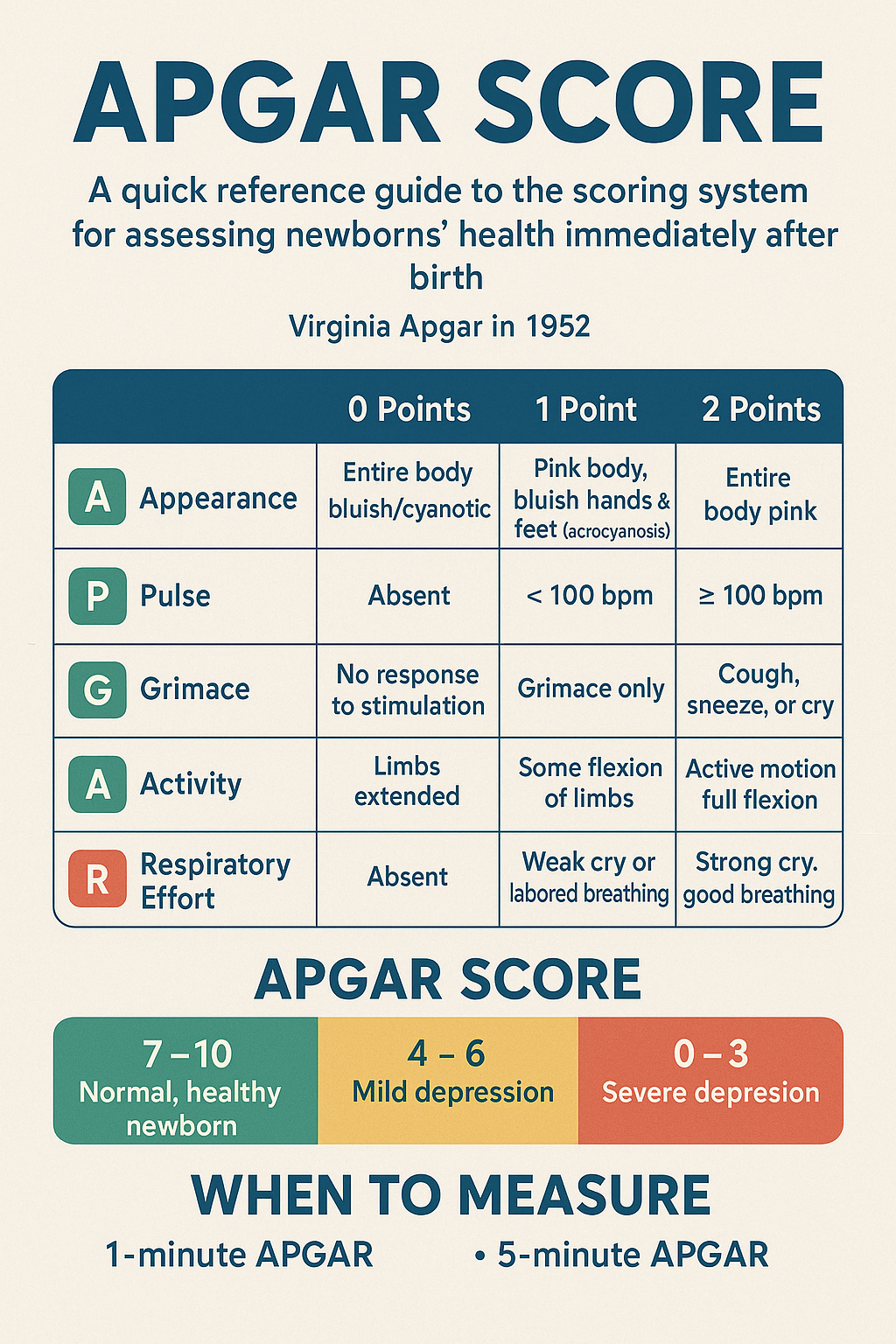
The APGAR score is a rapid method to assess the health status of a newborn immediately after birth.
It was introduced in 1952 by Dr. Virginia Apgar, an American anesthesiologist, to provide an objective and standardized evaluation.

The score is based on five parameters, each evaluated at 1 minute and 5 minutes after birth, with each parameter scored from 0 to 2. The maximum score is 10.


APGAR Parameters

LetterParameter0 Points1 Point2 Points
AAppearance (Skin Color)Entire body bluish/cyanoticPink body, bluish hands & feet (acrocyanosis)Entire body pink
PPulse (Heart Rate)Absent< 100 bpm≥ 100 bpm
GGrimace (Reflex Response)No response to stimulationGrimace onlyCough, sneeze, or cry
AActivity (Muscle Tone)Limbs extended (flaccid)Some flexion of limbsActive motion, full flexion
RRespiratory EffortAbsentWeak cry or labored breathingStrong cry, good breathing

Interpreting the APGAR Score

  • 7–10: Normal, healthy newborn
  • 4–6: Mild depression (needs observation and possibly mild intervention)
  • 0–3: Severe depression (needs urgent medical attention)

When to Measure

  • 1-minute APGAR: Reflects the newborn’s condition at birth and initial adaptation to the environment.
  • 5-minute APGAR: Evaluates the effectiveness of ongoing care and resuscitation efforts.
  • If the 5-minute score is < 7, assessment should be repeated every 5 minutes up to 20 minutes.

Practical Note for Delivery Rooms

  • Look & Listen: Appearance, activity, respiratory effort
  • Feel: Heart rate, reflex response (grimace)

This quick check can be done within seconds and helps guide immediate care for the newborn.


Summary:
The APGAR score remains one of the simplest and most effective tools for assessing newborn well-being. It does not predict long-term outcomes but is essential for guiding immediate care and determining if urgent intervention is required.


What is freeze indicator in vaccine? A guide


1. Definition

A Freeze Indicator is a device or label used to detect whether a vaccine (or other temperature-sensitive product) has been exposed to temperatures at or below its freezing point—usually 0°C or lower.

  • Purpose: To prevent use of vaccines that have lost potency or safety due to freezing.
  • Target vaccines: Mainly freeze-sensitive vaccines containing aluminum adjuvant (e.g., DTP, Pentavalent, Hep B, HPV), which lose potency irreversibly when frozen.

2. Types of Freeze Indicators

TypeFunctionExample Devices
Single-use chemical indicatorsChange color irreversibly after exposure to freezing temperature for a certain durationFreeze-tag®
Electronic data loggersRecord continuous temperature; can be set to trigger an alarm if freezing occursLogTag®, ELPRO
Phase-change indicatorsContain material that solidifies/melts at 0°C, showing visible changeSome cold chain box indicators

3. Working Principle

  • Based on phase change of a material or thermochemical reaction triggered by freezing temperatures.
  • The change is irreversible, serving as a permanent record of freezing exposure.

4. Interpretation (Using Freeze-tag® example)

  • OK: Indicator window shows ✓ (no freezing exposure).
  • ALARM / ❌: Indicator window shows a cross mark (freezing detected).
  • Device cannot be reset—once tripped, the product must be considered potentially damaged.

5. Pediatric Relevance – Vaccines Affected by Freezing

  • DTP / DT / Td
  • Pentavalent
  • Hepatitis B
  • HPV
  • Pneumococcal conjugate vaccine (PCV)
  • Inactivated polio vaccine (IPV)
  • Hib (liquid formulations)

Freeze-stable vaccines (e.g., OPV, measles, BCG before reconstitution) are not affected by freezing.


6. Field Handling Notes

  • Always check freeze indicator + VVM before using a vaccine.
  • Avoid placing freeze-sensitive vaccines in direct contact with ice packs.
  • In outreach, use conditioned ice packs (sweating surface, internal ice still solid).
  • If freeze indicator shows alarm → vaccine should be discarded as per national guidelines.

7. Limitations

  • Some indicators respond only to certain freezing durations (e.g., >60 min below 0°C).
  • Cannot detect multiple freeze–thaw cycles unless electronic logger is used.
  • Doesn’t measure heat exposure—must be paired with VVM for complete cold chain safety.

If you want, I can make you a side-by-side pediatric cold chain safety chart comparing VVMs vs Freeze Indicators with examples, WHO limits, and affected vaccines so it’s all in one quick-reference sheet.
Would you like me to prepare that?

Vaccine vial Monitoring: Note for Pediatrician


1. Definition

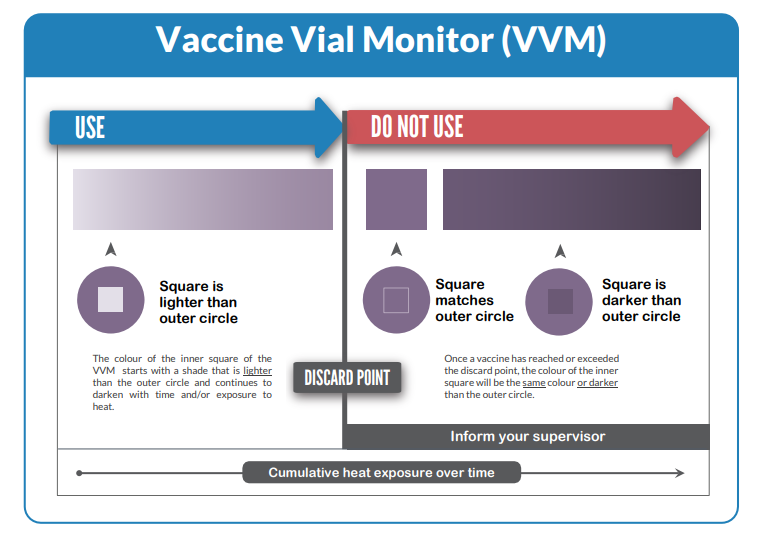
A Vaccine Vial Monitor (VVM) is a small thermochromic label placed on a vaccine vial, ampoule, or dropper to monitor cumulative heat exposure over time.

  • Purpose: Helps ensure that vaccines have not been damaged by excessive heat during storage or transport in the cold chain.
  • Function: Color changes irreversibly with time and temperature.

2. Components & Principle

  • Center Square: Heat-sensitive material that darkens progressively with heat exposure.
  • Outer Reference Ring: Fixed color for comparison.
  • Working Principle:
    • Heat causes a chemical reaction in the center square.
    • The higher the temperature, the faster the change.
    • Based on Arrhenius kinetics—reaction rate doubles with ~10 °C rise in temperature.

3. Reading a VVM

  • Acceptable: If center square is lighter than outer ring → vaccine usable.
  • Discard: If center square is same or darker than outer ring → vaccine compromised.

4. VVM Types & Vaccine Shelf Life

WHO assigns VVM categories depending on vaccine heat stability:

VVM TypeTime to end-point at 37 °CExamples
VVM30≥ 30 daysOral polio (OPV), Hep B
VVM14≥ 14 daysDTP, Pentavalent
VVM7≥ 7 daysRotavirus
VVM2≥ 2 daysCertain lyophilized vaccines (e.g., measles, BCG before reconstitution)

5. Storage & Handling Notes for Pediatric Use

  • Check VVM before every use—especially in outreach/immunization camps.
  • Do not refrigerate below recommended temperature just to “reset” VVM—it’s irreversible.
  • VVM is not a freeze indicator—separate freeze indicators are used for freeze-sensitive vaccines (e.g., DTP, Hep B).
  • Post-reconstitution: VVM is invalid for multi-dose lyophilized vaccines—time limit per WHO multi-dose policy applies.

6. Field Significance in Pediatrics

  • Ensures safe vaccines for children in peripheral settings where cold chain breaches are common.
  • Reduces wastage by allowing use of vaccines that have been out of refrigeration but still within VVM limit.
  • Prevents administration of heat-damaged vaccines, which could cause reduced immunogenicity without visible signs.

7. Limitations

  • Cannot detect freezing damage.
  • Not a substitute for proper cold chain monitoring (data loggers, ice packs, cold boxes).
  • Only indicates cumulative heat exposure—not precise real-time temperature.