1. Definition
A Freeze Indicator is a device or label used to detect whether a vaccine (or other temperature-sensitive product) has been exposed to temperatures at or below its freezing point—usually 0°C or lower.
- Purpose: To prevent use of vaccines that have lost potency or safety due to freezing.
- Target vaccines: Mainly freeze-sensitive vaccines containing aluminum adjuvant (e.g., DTP, Pentavalent, Hep B, HPV), which lose potency irreversibly when frozen.
2. Types of Freeze Indicators
| Type | Function | Example Devices |
|---|---|---|
| Single-use chemical indicators | Change color irreversibly after exposure to freezing temperature for a certain duration | Freeze-tag® |
| Electronic data loggers | Record continuous temperature; can be set to trigger an alarm if freezing occurs | LogTag®, ELPRO |
| Phase-change indicators | Contain material that solidifies/melts at 0°C, showing visible change | Some cold chain box indicators |
3. Working Principle
- Based on phase change of a material or thermochemical reaction triggered by freezing temperatures.
- The change is irreversible, serving as a permanent record of freezing exposure.
4. Interpretation (Using Freeze-tag® example)
- OK: Indicator window shows ✓ (no freezing exposure).
- ALARM / ❌: Indicator window shows a cross mark (freezing detected).
- Device cannot be reset—once tripped, the product must be considered potentially damaged.
5. Pediatric Relevance – Vaccines Affected by Freezing
- DTP / DT / Td
- Pentavalent
- Hepatitis B
- HPV
- Pneumococcal conjugate vaccine (PCV)
- Inactivated polio vaccine (IPV)
- Hib (liquid formulations)
Freeze-stable vaccines (e.g., OPV, measles, BCG before reconstitution) are not affected by freezing.
6. Field Handling Notes
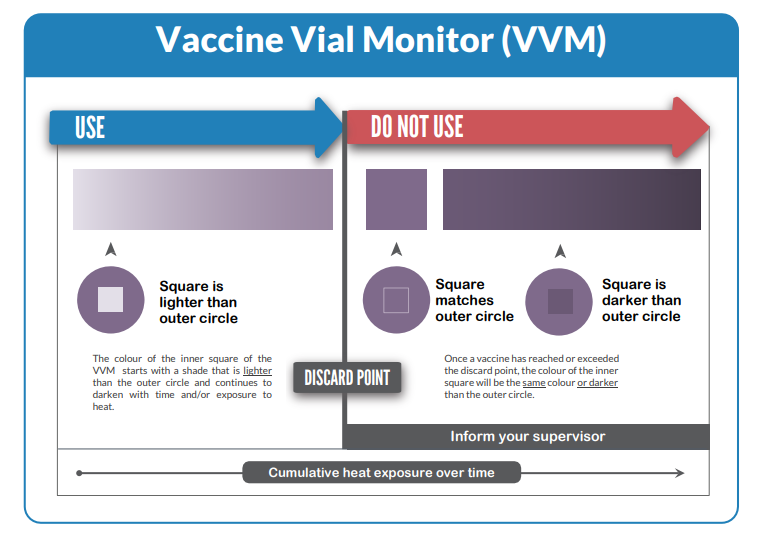
- Always check freeze indicator + VVM before using a vaccine.
- Avoid placing freeze-sensitive vaccines in direct contact with ice packs.
- In outreach, use conditioned ice packs (sweating surface, internal ice still solid).
- If freeze indicator shows alarm → vaccine should be discarded as per national guidelines.
7. Limitations
- Some indicators respond only to certain freezing durations (e.g., >60 min below 0°C).
- Cannot detect multiple freeze–thaw cycles unless electronic logger is used.
- Doesn’t measure heat exposure—must be paired with VVM for complete cold chain safety.
If you want, I can make you a side-by-side pediatric cold chain safety chart comparing VVMs vs Freeze Indicators with examples, WHO limits, and affected vaccines so it’s all in one quick-reference sheet.
Would you like me to prepare that?