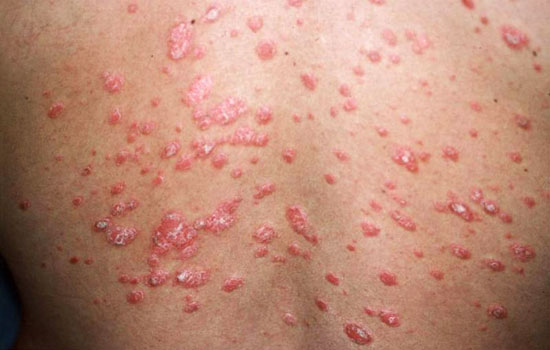
High-Yield Points: Guttate Psoriasis
Definition
- Acute eruption of small, drop-like (“guttate”) erythematous papules with fine scale
- Typically occurs suddenly, often after infection
Etiology & Triggers
- Strongly associated with:
- Post-streptococcal infection (especially Group A β-hemolytic streptococcus)
- Occurs 1–3 weeks after pharyngitis
- Other triggers:
- Viral infections
- Stress
- Trauma (Koebner phenomenon)
Epidemiology
- Common in:
- Children and young adults
- Often represents the first presentation of psoriasis
Clinical Features
- Numerous:
- Small (2–10 mm) teardrop-shaped papules
- Salmon-pink with fine scale
- Distribution:
- Trunk and proximal limbs
- Usually:
- Non-scarring
- Mild pruritus
- Face involvement may occur, especially in children
Diagnosis
- Primarily clinical
- Supporting findings:
- Recent sore throat
- Elevated ASO titer
- Skin biopsy (rarely required):
- Psoriasiform hyperplasia
- Parakeratosis
- Neutrophils in stratum corneum (Munro microabscesses)
Associations
- May:
- Resolve completely
- Progress to chronic plaque psoriasis
- HLA association:
- HLA-Cw6
Management
First-line
- Topical therapy
- Corticosteroids
- Vitamin D analogues
Moderate to Severe Disease
- Phototherapy (narrowband UVB) — treatment of choice
Infection-related
- Treat underlying:
- Streptococcal infection
- Penicillin if active infection is present
Prognosis
- Often:
- Self-limiting (weeks to months)
- Risks:
- Recurrence
- Progression to plaque psoriasis
Exam Pearls
- Sudden eruption after sore throat suggests guttate psoriasis
- “Raindrop lesions” on trunk
- Best treatment in widespread disease: NB-UVB phototherapy
- Differentiate from:
- Pityriasis rosea (herald patch, Christmas tree pattern)
MCQs
MCQ 1
A 14-year-old presents with sudden eruption of small scaly papules over trunk 2 weeks after sore throat. Most likely diagnosis?
A. Pityriasis rosea
B. Guttate psoriasis
C. Lichen planus
D. Secondary syphilis
Answer: B. Guttate psoriasis
MCQ 2
Most common trigger of guttate psoriasis:
A. Staphylococcal skin infection
B. Fungal infection
C. Streptococcal pharyngitis
D. Drug reaction
Answer: C. Streptococcal pharyngitis
MCQ 3
Best treatment for extensive guttate psoriasis:
A. Oral steroids
B. Methotrexate
C. Narrowband UVB phototherapy
D. Antibiotics alone
Answer: C. Narrowband UVB phototherapy
MCQ 4
Which HLA type is associated?
A. HLA-B27
B. HLA-Cw6
C. HLA-DR4
D. HLA-A3
Answer: B. HLA-Cw6
MCQ 5
Key distinguishing feature from pityriasis rosea:
A. Trunk involvement
B. Scaling lesions
C. History of streptococcal infection
D. Mild pruritus
Answer: C. History of streptococcal infection
MCQ 6
Most likely long-term outcome:
A. Always resolves permanently
B. Progresses to eczema
C. May develop chronic plaque psoriasis
D. Leads to skin cancer
Answer: C. May develop chronic plaque psoriasis
MCQ 7
Histological hallmark:
A. Hypergranulosis
B. Munro microabscesses
C. Acantholysis
D. Spongiosis
Answer: B. Munro microabscesses